
Built for long, humid River Region summers
Spray Foam Insulation in Montgomery, AL
Cooler upstairs rooms, drier crawl spaces and lower summer bills, with a written quote for every area.
- Free in-person estimates
- Written quote that lists material, thickness and R-value for each area
- Moisture, ductwork and pest damage checked before anything gets covered
Insulation for a Hot, Humid Capital City
Spray foam insulation in Montgomery has one main job: keeping a house comfortable through a long, sticky summer. The city's 1991-2020 climate normals on Wikipedia put the average July high at 93.7F and the average July low at 72.1F, with about 86 days a year reaching 90F and July relative humidity averaging 75.7%. A house that leaks air at the attic and the crawl space pulls that heat and moisture inside for months at a time. We seal those leaks and insulate the spaces that need it, using open-cell or closed-cell spray foam where it earns its cost and other materials where they do the job for less.
What the code asks for here
Montgomery County sits in IECC Climate Zone 3A, the warm and humid band that covers most of Alabama. The state's residential energy code is the 2015 IECC with Alabama amendments, in force since October 1, 2016. In the state-amended table for Zone 3, ceilings call for R-30, wood-frame walls R-13, floors R-19 and crawl space walls R-5 continuous or R-13 cavity insulation, and new homes must pass a blower door test at no more than 5 air changes per hour at 50 pascals. The Department of Energy recommends going further when you retrofit: R-49 to R-60 for an uninsulated Zone 3 attic, R-38 to R-49 added over 3 to 4 inches of existing insulation, and R-19 for an uninsulated floor. Code is the floor for new construction; it is not a comfort target for a 60-year-old ranch.
Where Montgomery houses lose the battle with summer
The city was incorporated in 1819, and its housing spans every era since. Houses in the Garden District and Cloverdale date from about 1875 to 1949, with tall ceilings, balloon framing and floors raised over open crawl spaces. Dalraida began selling lots in 1914. Post-war ranches fill much of the city, and newer subdivisions keep spreading east and south. Each type leaks in its own way.
Older homes often have wall cavities open from the crawl space to the attic, so hot attic air and damp crawl space air move freely through the house. Ranches tend to have thin, settled attic insulation and ductwork running across an attic that bakes all summer. Newer two-story homes often have a bonus room over the garage with kneewalls that let the attic heat right in. In nearly every house, the gaps around light fixtures, plumbing stacks, chases and the attic hatch leak far more than people expect.
Closed cell vs open cell in a humid climate
Open-cell foam is soft and light. It expands to fill a cavity, stops air movement well and costs less per inch, but it lets some water vapor pass. HomeGuide lists it at about R-3.5 to R-3.7 per inch. Closed-cell foam is dense and rigid, at R-5 to R-7 per inch, and at normal thickness it slows vapor and does not soak up water. Around Montgomery, open-cell is a common choice for the underside of the roof deck when an attic is being brought inside the conditioned space, and for interior walls where sound matters. Closed-cell is the usual pick under floors over damp crawl spaces, on crawl space walls, on metal buildings and anywhere that might see water.
Foam is not always the answer. A wide-open attic floor over a ranch house can often be sealed with foam and caulk at the leaks and then covered with blown insulation to depth for a fraction of the cost of foaming the roof deck. We tell you which approach suits each part of the house and why.
Crawl spaces, ducts and that musty smell
With about 51 inches of rain a year and humid air most months, many crawl spaces under River Region homes stay damp. Outside air full of moisture drifts in through the vents and meets cool floor framing and ductwork, and the result is sweating ducts, cupped floors, mold on joists and sagging fiberglass batts. Closing and conditioning the crawl space, sealing the vents, laying a heavy vapor barrier and insulating the walls instead of the floor is one fix. Closed-cell foam on the underside of the floor is another. Which one fits depends on drainage, the duct layout and whether there is a gas appliance down there.
Questions to ask insulation contractors
When you call spray foam insulation contractors or insulation companies around Montgomery, a few questions sort them out fast. What will you seal before you insulate? Which foam will you use in each area, at what thickness and R-value? If you foam the roof deck, how will you handle the attic air and any gas furnace up there? How long should we stay out of the house after spraying? (HomeGuide advises planning on at least 24 hours.) What happens to old, wet or rodent-soiled insulation? Is the price broken out by area? If an answer stays vague, keep asking. We put those details in writing for every job.
Spray foam insulation cost
HomeGuide's 2026 guide puts installed spray foam at $1.50 to $5.00 per square foot, with open-cell at $1.50 to $3.50 and closed-cell at $3.00 to $5.00. It lists a whole house at $8,000 to $20,000, a crawl space at $2,000 to $4,000, and notes that many installers charge a job minimum of $1,000 to $2,000 or more. Fixr's 2025 figures run $3.15 to $7.50 per square foot for existing walls. These national numbers are good for budgeting, but foam type, thickness, attic access, prep work and old material that has to come out set the real cost. The number on your written estimate is the one you pay.
When to schedule
Attic work is easiest from fall through spring, when the space is not baking, though we do it year-round with early starts in summer. Crawl spaces and walls can be done any month. Spring and early summer fill up as people feel the first heat, so booking an estimate in winter gives you the widest choice of dates.
Where We Work
We work across Montgomery and the River Region, from older in-town neighborhoods to the fast-growing suburbs and the small towns along the Coosa, Tallapoosa and Alabama rivers. The houses change from place to place. Prattville and Millbrook are mostly suburbs that grew after Interstate 65 arrived, with plenty of 1980s through 2000s homes. Pike Road went from 310 residents in 2000 to 9,439 in 2020, so most of its houses are young. Wetumpka, Tallassee and Tuskegee have older town centers with antebellum and early-1900s buildings, and the lake country around Eclectic and Deatsville mixes year-round homes with weekend places.
All of it sits in Climate Zone 3A, where the problem is humid heat more than cold. Each town page lists what we found about that town and how it shapes the insulation work.
- Spray Foam Insulation in Montgomery, AL
- Spray Foam Insulation in Prattville, AL
- Spray Foam Insulation in Millbrook, AL
- Spray Foam Insulation in Wetumpka, AL
- Spray Foam Insulation in Pike Road, AL
- Spray Foam Insulation in Tallassee, AL
- Spray Foam Insulation in Tuskegee, AL
- Spray Foam Insulation in Deatsville, AL
- Spray Foam Insulation in Elmore, AL
- Spray Foam Insulation in Coosada, AL
- Spray Foam Insulation in Eclectic, AL
- Spray Foam Insulation in Hayneville, AL
- Spray Foam Insulation in Hope Hull, AL
- Spray Foam Insulation in Autaugaville, AL

Common Questions
What is the downside of spray foam insulation?
It costs more per square foot than fiberglass or cellulose, and it is hard to remove once it cures. It has to be mixed and sprayed correctly, and the house should be empty during application and for about a day after. Foaming the roof deck also changes how the attic works, so ductwork, gas appliances and ventilation need to be planned in.
Why does spray foam insulation cost so much?
The chemicals cost more than loose fill, the rig and protective gear are expensive, and the crew seals air leaks and insulates in the same step. HomeGuide puts installed foam at $1.50 to $5.00 per square foot versus $1.00 to $2.80 for blown-in. In return you get an air seal that loose fill does not provide on its own.
Is open cell or closed cell better for a Montgomery home?
It depends on the spot. Open-cell works well on the underside of the roof deck and in interior walls. Closed-cell is the usual choice under floors over a damp crawl space, on crawl space walls and on metal buildings, because it resists water and slows vapor.
How much attic insulation does a house in Montgomery need?
Alabama's amended energy code calls for R-30 in ceilings of new homes in Zone 3. The Department of Energy recommends R-49 to R-60 for an uninsulated Zone 3 attic, or adding R-38 to R-49 over 3 to 4 inches already in place. We measure what you have and quote to a target R-value.
Should I insulate my crawl space or seal it?
In a humid climate, a vented crawl space with fiberglass batts under the floor often ends up damp, with sagging insulation. Closing the crawl space and insulating its walls, or spraying closed-cell foam under the floor, usually holds up better. We check drainage, grading and ductwork first, since standing water has to be fixed before either option.
Does Home Depot offer spray foam insulation?
Home centers sell small foam kits and cans for gaps and small areas. A whole attic, crawl space or wall system takes a heated, two-part rig and a trained crew so the foam mixes and cures correctly. For large areas, get a written quote from an installer.
What We Insulate
Six services built around Montgomery houses: hot attics, damp crawl spaces, old walls and metal buildings.
Spray Foam Insulation
Open-cell and closed-cell foam for roof decks, walls, floors and outbuildings, matched to each surface.
Learn more →Crawl Space Insulation & Encapsulation
Sealed, drier crawl spaces with insulated walls or foamed floors, built for Alabama humidity.
Learn more →Attic Air Sealing & Insulation
Sealed attic floors topped to depth, or foamed roof decks when ducts live in the attic.
Learn more →Wall Insulation
Foam for open walls in additions and new builds, and blown fill for closed walls in older homes.
Learn more →Metal Building & Shop Insulation
Closed-cell foam for steel shops, barns and garages that sweat in summer and bake in the sun.
Learn more →Insulation Removal & Replacement
Wet, moldy or rodent-soiled insulation removed and replaced with a sealed, clean installation.
Learn more →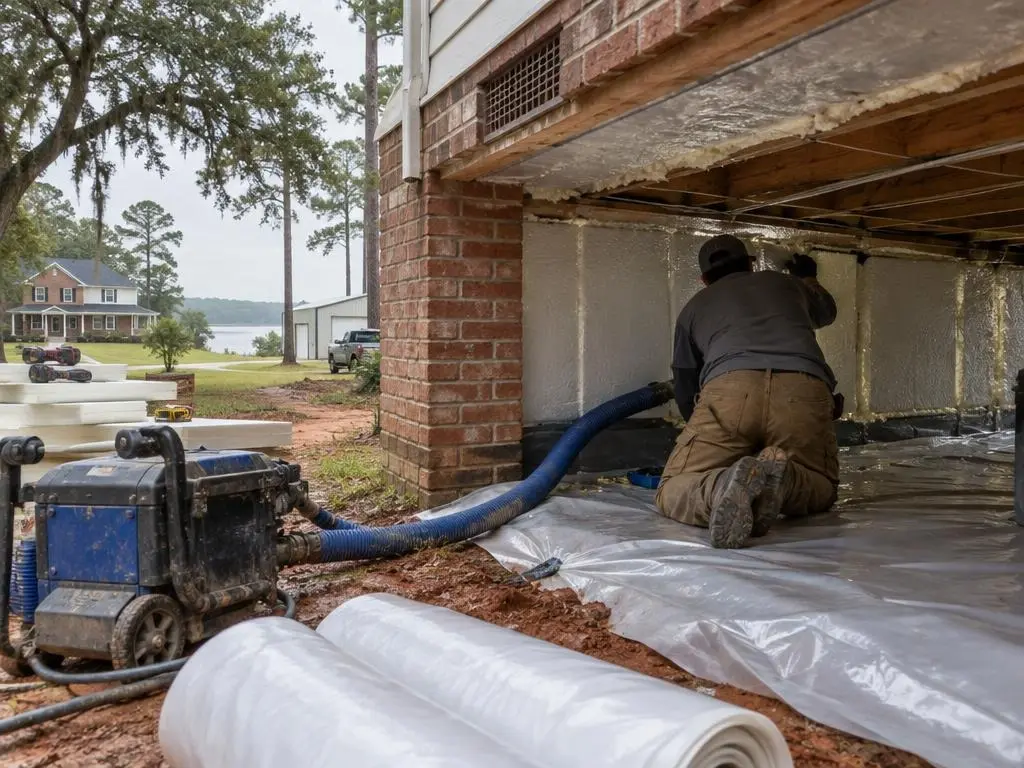
Why Homeowners Call Spray Foam Insulation Montgomery
We inspect before we price
Every quote follows a visit to the attic, the crawl space and any building you want insulated.
Moisture comes first
Wet crawl spaces, sweating ducts and roof leaks get flagged and addressed before insulation covers them.
The right material for each space
Open-cell, closed-cell or blown fill, chosen for the surface and the moisture risk, with the reason written on the quote.
A quote you can compare
Each area shows the material, thickness or depth, target R-value and price, so you can line it up against other bids.
Get a Spray Foam Insulation Estimate
We look at the attic and crawl space, then send a written price.